
Key Takeaways
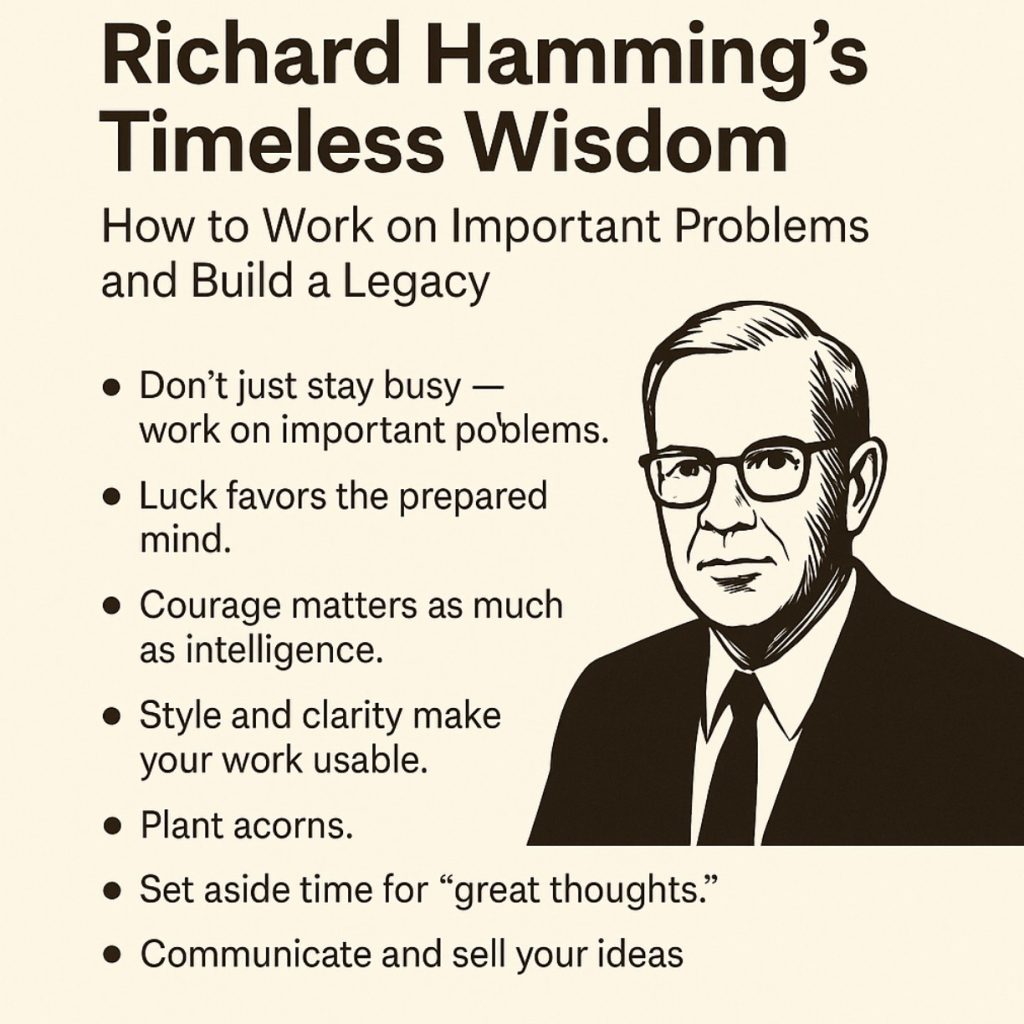
- Stop being busy and solve important problems.
- Luck favors a prepared mind. Preparation creates a “lucky break.”
- Courage is as important as intelligence. Big risks lead to big rewards.
- Style and clarity make your work useful. Make it teachable and buildable.
- Plant acorns. Small ideas can grow into big contributions.
- Set aside time for “big thoughts.” Reflection drives innovation.
- Communicate and sell your ideas. If no one listens to you, your ideas won’t spread.
Introduction: Why the 1980s Conversation Still Matters Today
Imagine sitting in a small classroom in 1986. White-haired mathematician Richard Hamming takes the stage and begins speaking about science, technology, and success in life. Within minutes, you realize that you are not listening to a routine lecture, but a master class on how to live a meaningful professional life.
Hamming was not just a professor. he is Pioneer at Bell LaboratoriesIt is the birthplace of revolutionary technologies such as transistors, lasers, information theory, and computer operating systems. Surrounded by giants like Claude Shannon and John Tukey, Hamming asked simple yet pointed questions.
Why do some people achieve greatness while others, equally smart, do not?
His reflections have now become famous lectures. “You and your research.” Decades later, these lessons remain extremely relevant, not only to scientists, but also to entrepreneurs, product leaders, students, and anyone seeking impact.
This article guides you through the following steps: Key takeaways from Hamming’s talkexplain general englishConnect this to: Modern life and work.
Who was Richard Hamming?
Richard Wesley Hamming (1915–1998) was an American mathematician and computer scientist. His fingerprints are on some of the most fundamental contributions to the field of technology.
- Hamming code (error detection and correction): Without them, reliable digital communications would not exist. Every time your smartphone streams a video without a problem, you indirectly thank Hamming.
- Numerical Analysis and Calculations: He influenced the way early computers were used in science.
- Bell Labs Innovators: Working with legends, he has witnessed how world-changing ideas are born.
But Hamming was more than just a technical genius. He too was deeply reflecting. Habits, mindset, choices This is what distinguishes a good scientist from a good scientist.
Why his speech became legendary
“You and Your Research” is not about math or code. It’s about How to live as a person who thinks, acts, and does important things.
Hamming shared personal stories, lessons learned at Bell Labs, and keen observations about his colleagues. He was not afraid to call out laziness, lack of courage, and wasting time. But he delivered it with humor and humility.
This talk resonates because it answers timeless questions.
- How do you choose what to do?
- What role does luck actually play?
- Why do brilliant people sometimes achieve so little?
- How can you maximize your impact?
Lesson 1: Solve Big Problems
Hamming’s first and biggest claim is this:
If you’re not solving important problems, you’re wasting your time.
Too many talented people spend their days doing small tasks that are safe and achievable but unimportant.
What is a “material issue”?
- that Move your field forward In a meaningful way.
- that Create tools or knowledge It’s something others can build on.
- that continue — It’s not a short-term win, it has long-term impact.
Table: busy work and important work
| busy work | important work |
|---|---|
| Endless bug fixes without addressing the root cause | Build a system to eliminate all kinds of bugs |
| Writing routine reports | Write a paper that defines a new standard |
| Optimized for today’s deadlines | invent something that will shape the next decade |
modern example
Think of Google in the early 2000s. Thousands of people were working on search engines. The “busy work” was coordinating the results. It was about finding out “what matters.” How to meaningfully rank your pages at scale — Larry Page and Sergey Brin’s PageRank solved this problem, and the rest is history.
Lesson 2: Luck Favors the Prepared Mind
Hamming liked what Pasteur said.
“Luck favors the prepared.”
Yes, luck is important. but you can create good luck By putting yourself in the right situation.
How to Prepare for Luck
- Read widely: New relationships come from unexpected places.
- Stay curious: Ask innocent questions that others ignore.
- Be prepared to pivot. When an opportunity presents itself, act.
Example: microwave oven
Raytheon’s Percy Spencer was working near a radar magnetron when he noticed a candy bar melting in his pocket. Instead of ignoring it he I followed my curiosity — And then I discovered microwave cooking.
luck? yes. but also You must be aware and ready to act.
Lesson 3: Courage over comfort
Hamming observed that many smart people avoid risk. They settle into routine, avoiding criticism or failure.
“Courage is not just about doing something dramatic, it’s about daring to do what others think you can’t do.”
courage to act
- Presenting a bold new theory to skeptics.
- Propose an unconventional design to your boss.
- We publish research that challenges orthodoxy.
modern metaphor
Elon Musk bet on SpaceX when most experts thought private spaceflight was impossible. That was courage.
Lesson 4: The Matter of Style and Clarity
Another overlooked factor: style.
Solving a problem isn’t enough. If your solution is messy, vague, or cannot be extended by others, your contribution dies along with it.
Hamming urged people to:
- Simplify your results. Make it elegant and clear.
- generalize Solve multiple problems, not just one case.
- teach. Package your work so others can use it.
yes
Newton didn’t just calculate the motion of the planets. he formulated laws of motion Anyone can apply. This is why his work has endured for centuries.
Lesson 5: Planting Acorns
Not all innovations start out big.
“You can plant acorns and grow a lot of oak trees.”
If a small idea is nurtured well, it can grow into a big contribution.
How to Plant Acorns Today
- Write a small script that will later become a product.
- Publish a blog post that develops into a book.
- Explore side projects that could become your startup.
Think of GitHub. It started like this: This is a small project whose code can be easily shared. Today, it powers the global software ecosystem.
Lesson 6: Open doors and the right thing to do
Hamming would leave his office door open. It made him accessible, but it also exposed him. Constant interruptions.
Eventually, he switched to a semi-open, semi-closed model. In other words, the model is accessible enough for collaboration, but closed enough for focus.
lesson: Maintain a balance between serendipity and deep work.
Lesson 7: Invert the Problem
Hamming is recommended if you get stuck. reversal — Turning the problem on its head.
yes
Instead of asking “How can I make better candles?” ask “How can I get rid of the darkness?” — And you invented the light bulb.
This pattern of thinking appears in design, entrepreneurship, and science.
Lesson 8: Consistent Investment – Make Your Efforts Add Up
Hamming argued that more hours of focus per day makes the difference between average and outstanding.
“Knowledge and productivity equal interest.”
modern parallel
Consider an open source contributor who writes code for an hour every day. Over the course of 10 years, they become leaders in their communities through sustained effort, not explosive effort.
Lesson 9: Selling Your Ideas
Great ideas don’t sell themselves.
- Talks: It will be vivid, attractive and memorable.
- Writing: Simplify. Make it readable.
- Informal Chat: Share your passion for coffee.
If you can’t explain your work to others, your reach will be limited.
Lesson 10: Schedule “Great Ideas”
Perhaps the most actionable of Hamming’s advice is this:
Take time regularly to step back and think about the big picture.
He suggested asking the following questions every Friday afternoon:
- Am I working to solve the most important problems?
- What new opportunities come to mind?
- Should I change direction?
In today’s world of Slack, email, and endless Zoom calls, this advice is pure gold.
Richard Hamming’s Playbook for Greatness
Here is a summarized routine based on his lecture:
| habit | action |
|---|---|
| Solve important problems | Regularly evaluate whether your key tasks are linked to lasting impact. |
| Get ready for luck | Be curious, read widely, and engage in interdisciplinary discussions. |
| Build courage | Take on bold ideas despite the risks |
| Focus on style | Make your tasks simple, common, and reusable. |
| planting acorns | Nurturing small projects |
| balance openness | Be accessible but secure over long working hours. |
| inversion problem | Flip your perspective when you’re stuck |
| steady investment | 1 additional hour of focus time each day |
| sell ideas | Improve conversation, writing, and informal presentations |
| plan a good idea | Weekly Reflection Block Scheduling |
Why This Will Still Matter in 2025
Hamming spoke to scientists in 1986. But his insights are universal.
- For product managers: Work on important features, not just backlog tickets.
- For entrepreneurs: Bet bravely, but stay prepared.
- For students: Don’t just study; think about the important questions in your field.
- For leaders: Create an environment where big problems are solved, not avoided.
AI, remote work, advice from Hamming in a rapidly changing era Focus on influence, courage, and clarity This is more important than ever.
Conclusion: Hamming’s challenge to us
At the end of the lecture, Hamming asked the audience directly:
“Why don’t you do something meaningful this life?”
I didn’t mean to be insulting. That was an invitation.
It’s an invitation to stop hiding behind busy work, stop waiting for luck, and start living an intentional life.
Whether you’re into coding, teaching, design, or leadership, Hamming’s message is clear:
Solve problems that matter. Prepare your heart. Be bold. Share your ideas. Reflect often.
This is how you build a legacy, not a career.
References
- Richard W. Hamming; you and your research (1986)
- Bell Labs archives and Hamming code literature
- YouTube: Richard Hamming lectures, learn to learn playlist