When Donald Trump returned to power, he did so with a promise that he repeated with unusual clarity: The United States, he said, had spent too much time fighting other people’s wars.The promise was fundamental to his political identity. Trump campaigned on ending the wars in Ukraine and Gaza, negotiating stability across the Middle East, and putting “America First” at home, promising a return to what he called the country “golden age.” The message also focused heavily on domestic concerns, cutting costs, combating the affordability crisis and making everyday life cheaper for American families. When, instead, the United States launched its campaign against Iran under the almost caricatured title “Operation Epic Fury,’ it was hard to miss the contrast with those promises.
The Internet quickly offered its own alternative name for the moment: “Operation Epstein Distraction” a sardonic label that suggests the war came at a remarkably convenient time for a president whose name has repeatedly come up in discussions surrounding the Jeffrey Epstein files.He often presented himself as a negotiator who could restore stability to a disordered world through negotiation and the force of his personality. He sometimes spoke of the prospect almost jokingly, suggesting that if the conflicts he claimed he could resolve were resolved, the magnitude of the achievement could well put him in contention for the job. Nobel Peace Prizean ambition that he openly pursued and that, in January 2026, produced a symbolic moment when Venezuelan opposition leader María Corina Machado presented him with her Nobel medal at the White House in gratitude for the US operation that removed Nicolás Maduro from power, a gesture intended as a show of gratitude and personal recognition, even though the Nobel Committee made clear that the peace prize itself cannot be transferred or shared.
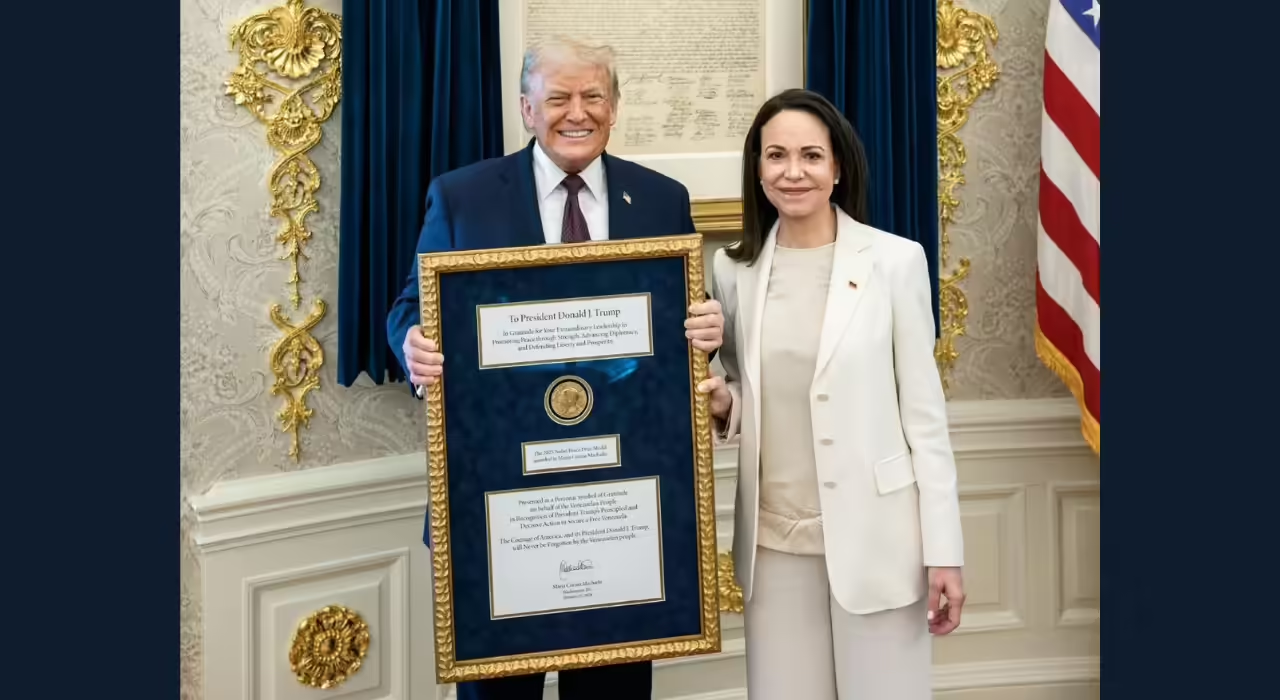
María Corina Machado presented Trump with his Nobel medal at the White House / Image: Whitehouse
However, by the end of 2025, the language had begun to change. In early December, Trump dismissed concerns about the rising cost of living, an issue that had dominated much of his campaign rhetoric, describing the affordability crisis as a “hoax,” a “false narrative” and a “scam” created by Democrats.A few weeks later, in January 2026, he spoke more openly about his frustration with the Nobel Committee after being again passed over for the Peace Prize. Trump said he had helped stop eight wars but had received no recognition. The committee, he suggested, was influenced by Norway’s political establishment, a criticism that quickly spread to broader political grievances when it threatened to impose tariffs on Norway and revived its demand that the United States should take control of Greenland, a Danish territory it has long argued is strategically important.During the same remarks, Trump said he no longer felt obligated to “think only about peace.” Although he insisted that he didn’t care about the prize itself – “I don’t care about the Nobel Prize,” he said, adding that his priority was “saving lives” – the change in tone was hard to ignore.Within weeks, the United States had entered into a direct military confrontation with Iran.
From peacemaker to war president
The shift from campaign rhetoric to military action came with Operation Epic Fury, the large-scale U.S. campaign that targeted Iranian missile facilities, naval bases, and other strategic sites. The strikes had immediate consequences. Among those killed was Ayatollah Ali Khamenei, Iran’s supreme leader, whom Donald Trump later described in Truth Social as “one of the most evil people in history.”The White House presented the operation as decisive and necessary, arguing that overwhelming force was needed to dismantle Iran’s ability to threaten American allies and regional stability. Israeli Defense Minister Israel Katz described the strikes as a “pre-emptive strike” designed to eliminate immediate threats to Israel, while US Secretary of State Marco Rubio said Washington had acted in anticipation of Iranian aggression.Trump himself offered several explanations for the campaign, pointing at different times to Iran’s nuclear ambitions, its ballistic missile program and its network of militant groups across the Middle East. Critics, however, have focused on the way those justifications have changed. Intelligence assessments have complicated some of the administration’s claims: An analysis by the U.S. Defense Intelligence Agency suggested that Iran was unlikely to possess missiles capable of reaching U.S. territory until 2035, raising questions about the immediacy of the threat. Others noted that if the central goal was to stop Iran’s nuclear program, Trump had previously declared that program “deleted” during previous attacks on Iranian facilities.
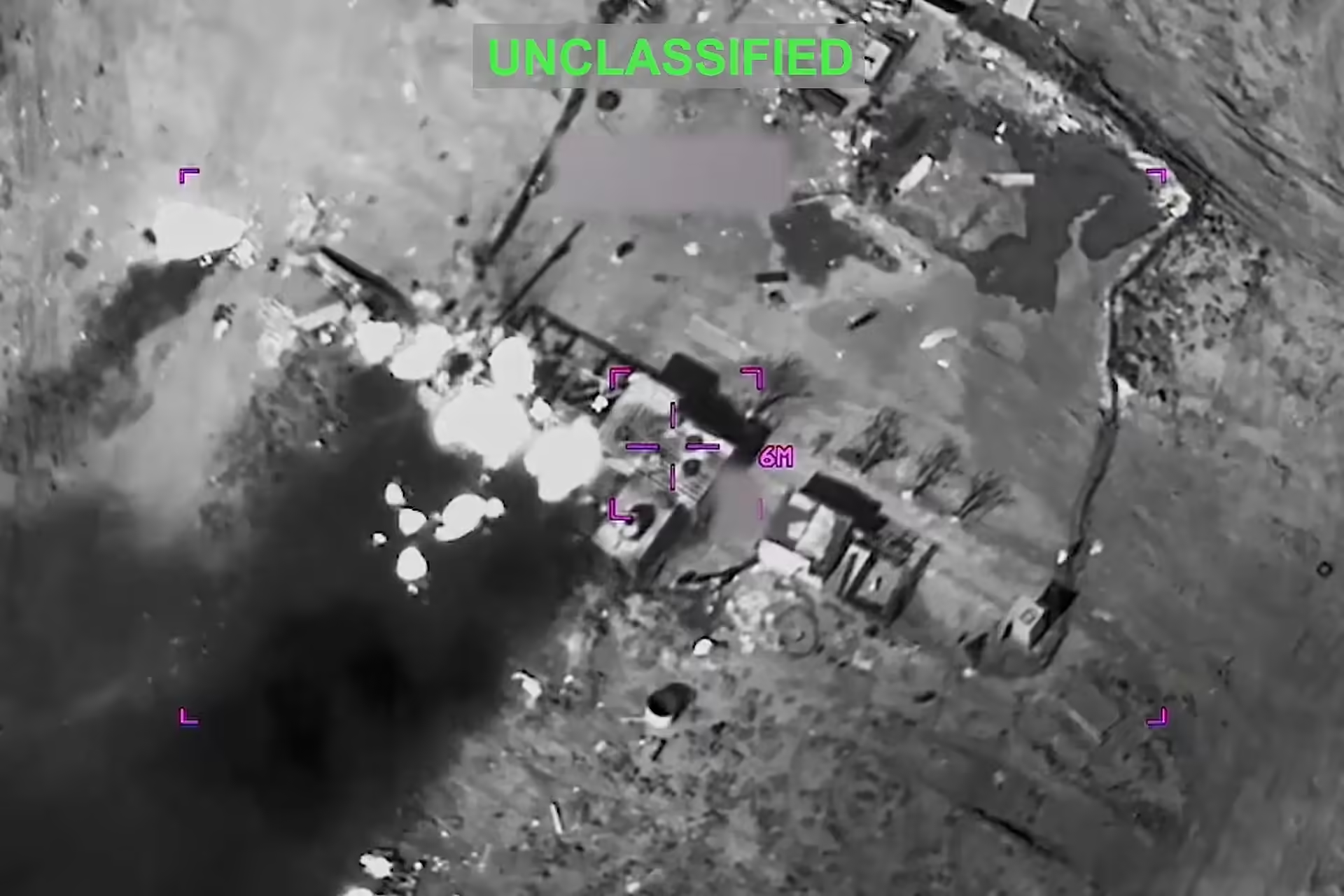
This partially redacted image from video provided by U.S. Central Command shows a complex of structures in Iran attacked by missiles fired by U.S. forces on Sunday, March 1, 2026. (U.S. Central Command via AP)
The human cost of war has also increased rapidly. In Iran alone, more than 1,255 people have been killed and more than 12,000 injured, according to the latest casualty trackers. Among the victims were at least 168 children, including 165 primary school girls, who were killed when a missile attack hit the Shajareh Tayyebeh Primary School in Minab, southern Iran, while they were in class.Retaliatory attacks have expanded the conflict beyond Iran’s borders: Israel has reported 13 dead and nearly 1,929 wounded, eight US soldiers have been killed in the Gulf and 18 wounded, and renewed Israeli operations in Lebanon have left more than 570 dead and more than 1,400 wounded. Iran has responded with drone and missile attacks across the Gulf, targeting sites in Saudi Arabia, the United Arab Emirates, Bahrain, Jordan, Oman, Qatar and Cyprus, causing deaths and injuries to civilians and military personnel, compounding the human toll and raising tensions in an already fragile region.
The family critic
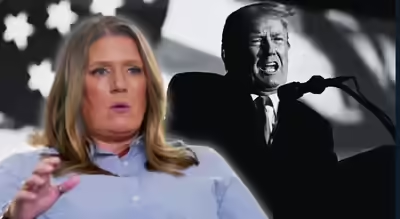
Among the many critics of the war, one voice has unusual authority not because of its political position but because of its proximity. Mary L. Trump, the president’s niece and daughter of his late older brother, Fred Trump Jr., has spent years analyzing the internal dynamics of the Trump family and the psychological forces that shaped it. she believes it shaped her uncle’s worldview. As a trained psychologist, she made that argument most famously in her best-selling memoir: Too Much and Never Enough: How My Family Created the World’s Most Dangerous Man a portrait of a family culture that she describes as defined by competition, emotional deprivation and incessant demands for dominance.In his telling, family patriarch Fred Trump Sr. ruled the household with a cold, transactional logic that rewarded strength and punished vulnerability. Maria describes it as a “high functioning sociopath” a father who fostered rivalry between his children while equating weakness with failure. Donald Trump, he writes, grew up in the shadow of his older brother Fred Trump Jr., who initially appeared to be the natural heir to the family business. When Fred Jr.’s struggles forced him out of that role, Donald took over, absorbing a lesson that Mary believes became central to his personality: humiliation must be avoided and dominance must be asserted before it can be imposed on you.
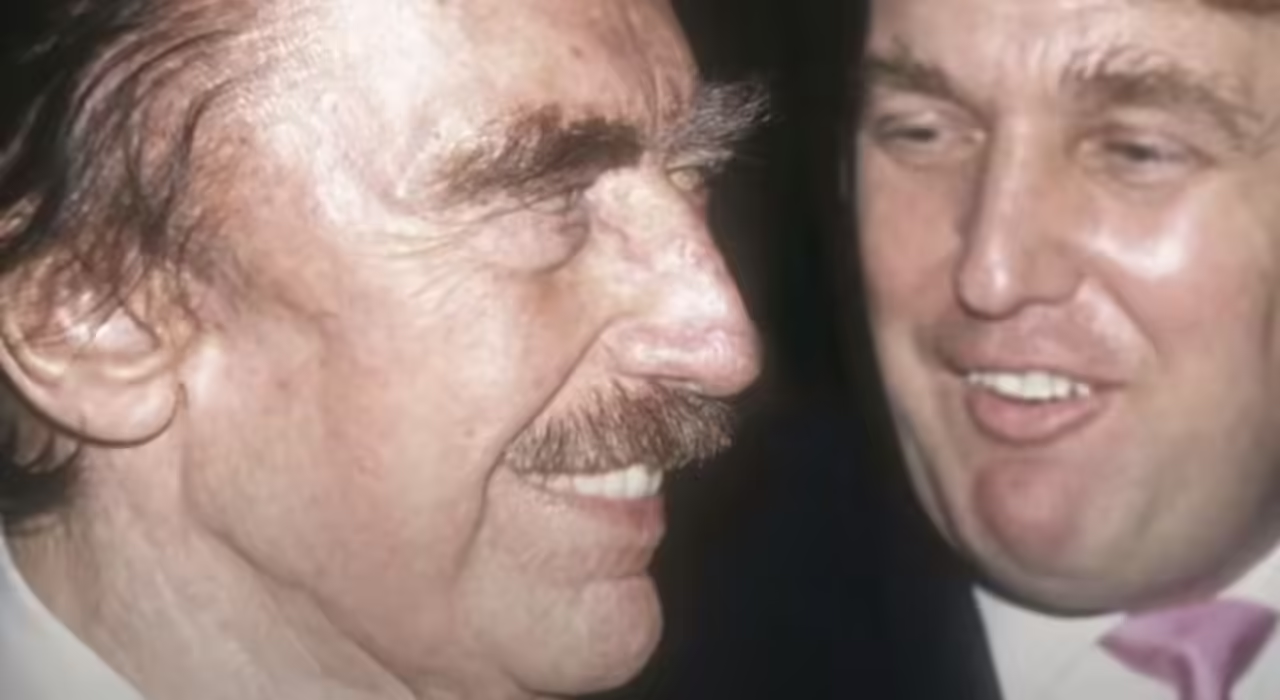
Fred Trump with his son Donald. Image: ABC News
That psychological framework, he argues, offers a clearer explanation for the Iran war than the official political arguments offered by the administration.Speaking on her YouTube channel Mary Trump Media, described by the channel itself as: “You may know Donald Trump as the authoritarian conman who tore the country apart from the Oval Office. Mary Trump just knows him as her fucking loser uncle. “This channel is where fake news goes to die.” He acknowledged the suffering of ordinary Iranians under the country’s political system, but rejected the idea that the American campaign was motivated by any significant concern for their future. ““The Iranian people have long suffered horribly under the cruel and repressive authoritarian theocracy currently in power.” he said, adding that they deserve the freedom to determine their own system of government. But she argued that the American president who ordered the bombing did not have that goal. “The man who is bombing their country has no interest in them and has no plan to create the conditions in which they can be free.”Mary Trump’s explanation is not primarily geopolitical. It’s psychological. In her opinion, the war reflects a familiar pattern in her uncle’s behavior, a pattern that she believes has defined his career in both business and politics.“For Donald, there is one reason and one reason only.” she said. “He’s in trouble and he knows it. It’s not just about changing the subject. That, of course, would be bad enough. This is to prevent him and the world from knowing that he is an inept, depraved and compromised fraud.”She added: “It’s about his unfathomable desperation to avoid being humiliated. Donald Trump has led us to war at the behest of Saudi Arabia and Israel. But that would not have been a sufficient reason if doing so did not also coincide with their own interest.”It also describes a dynamic in which disruption becomes a method of control. Trump, says, “He wreaks havoc and then expects other people to pick up the rubble of his destruction.” a pattern that has often allowed him to evade responsibility while forcing others to manage the consequences.
The question she keeps asking
Mary Trump has expanded on that argument in a blog post titled“What is all this for?” where it challenges the strategic logic behind the conflict itself. If the war is intended to protect American interests, he asks, the benefits are difficult to identify.“In what universe does starting a war of choice against a nation that posed no imminent threat to us help the bottom line for the American people?” she wrote. “How exactly is a war of choice on the other side of the world going to improve the lives of the American people? There’s no good answer to that question. There’s not even a coherent answer.”For her, the shifting explanations of the conflict—nuclear deterrence one week, regime change the next—reinforce the suspicion that there was never a consistent strategic logic. “The rationale for this war has changed repeatedly, meaning there was no legitimate reason to wage it in the first place.”His criticism also extends to the broader consequences of the conflict. The war, he warns, will cost “untold lives and untold billions of dollars.” while damaging the credibility of the United States among its allies. “Our allies are already suspicious of us and we will no longer be able to be perceived as a nation that can be trusted or taken seriously.”The danger, he maintains, lies not only in the immediate destruction but in the volatility of the region itself. “The Middle East is a powder keg.”
The costs of a war far from home
Events since the beginning of the conflict have begun to illustrate exactly what she meant. Iran’s response has included threats to choke the Strait of Hormuz, the narrow waterway through which much of the world’s oil and liquefied gas passes. Even the possibility of a disruption has already caused turbulence in energy markets. Fuel and LPG prices have soared in many countries, forcing small businesses and restaurants to cut back or close and adding pressure on households already struggling with rising costs.The economic shock goes directly against Trump’s campaign agenda. His return to power was framed by cutting costs, addressing the affordability crisis, and making everyday life cheaper for Americans. A conflict that pushes up global energy prices does the opposite.
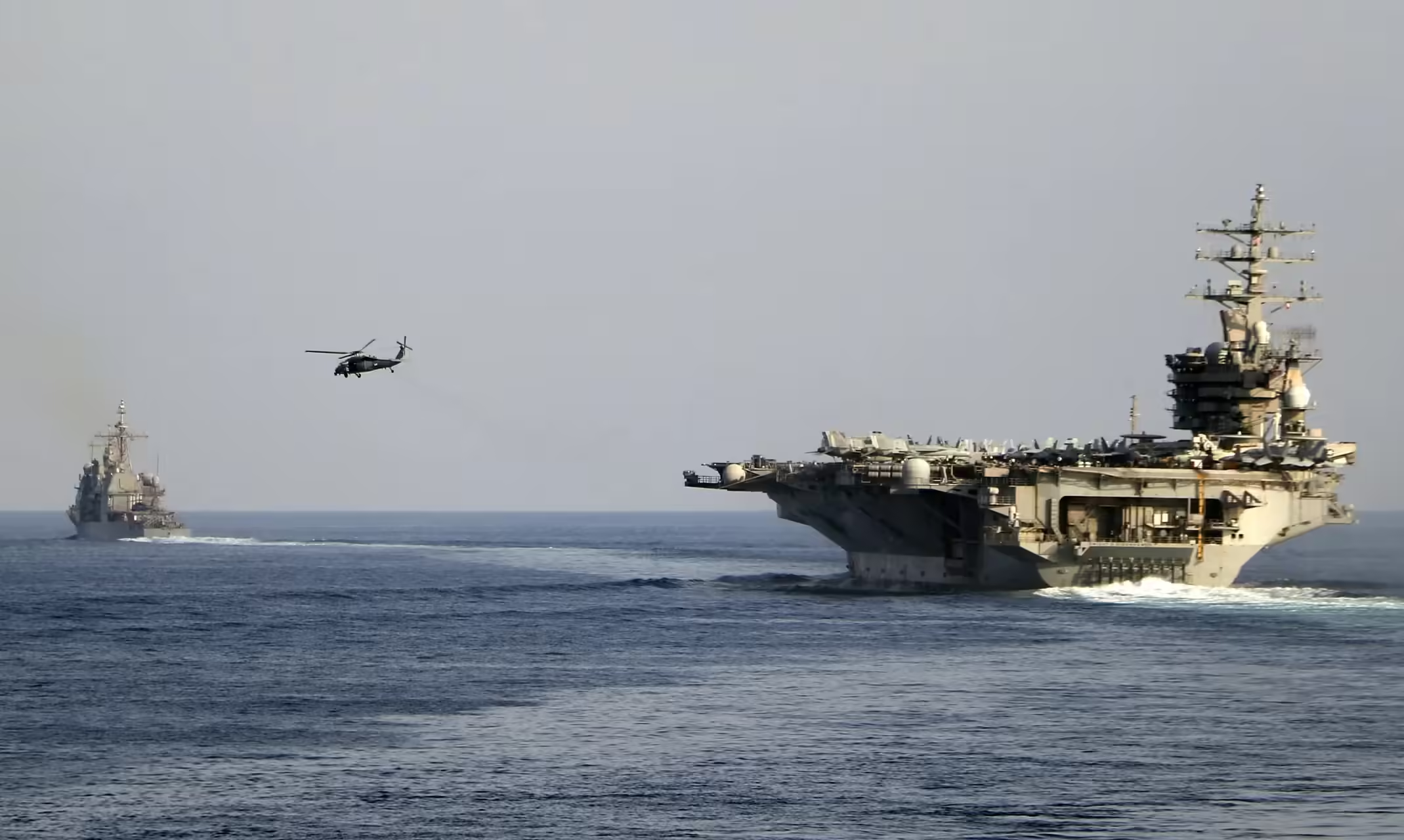
The aircraft carrier USS Dwight D. Eisenhower and other warships cross the Strait of Hormuz, which is a vital route for oil, into the Persian Gulf.
Mary Trump maintains that the contradiction is not accidental. When the president insists that the economy is strong enough to absorb shocks, he argues, he is describing the world as it appears from the point of view of extreme wealth. The people who make the decisions, he says, are insulated from the pressures that ordinary Americans face.“They will continue to make more money because the person who runs the United States of America is the most greedy and corrupt crook in modern history.” she wrote. The consequences of the war, the economic strain, the risks to American soldiers, the devastation in Iran, fall elsewhere.“If you’re struggling to pay your bills, if you’re facing a deductible that could ruin you financially, if you’re wondering how you’re going to be able to shop next month,” he wrote, “understand this: None of this is accidental.”“They are isolated. They are enriched. They are protected.”“Not you.”