When a friend gave me the Cloud Strife Magic: The Gathering card, I felt quite intimidated. It’s a reprint of the wickedly powerful Najeela, Blade-Blossom, the type of commander opposing players immediately target. Najeela, a 3/2 human warrior that costs two colorless mana and one red mana, generates a warrior creature token every time a warrior attacks, but the key detail is her second ability. For five mana (one of each color) you can untap all attacking creatures and give them trample, lifelink, and haste. and gives you an extra combat phase after that. Because of the ability, that means a commander deck with Cloud Strife/Najeela at the top has access to all five colors and a very clear path to victory.
All told, the overall strategy is pretty simple: raise a variety of mana, fill your board with warriors, keep attacking to spawn more warriors, and finally activate the ability in the middle of combat. However, having a five-color deck means that you must carefully calculate the mana costs of all your cards and balance your lands and other mana generators accordingly. There are also many directions you can potentially deviate. The warrior appears as a creature subtype in all types of sets. While it is possible to develop this using only final fantasy cards, I had a lot of fun pulling out the newer sets and embracing the weirdness of Universes Beyond, especially when I added Raphael and Leonardo from Teenage Mutant Ninja Turtles in the mix.
Raph & Leo, Sibling Rivals is one of the many team cards in the TMNT set, which combines two characters into one legendary creature. Although the card is a mutant ninja turtle and not a warrior, his ability works very well here. Each time Raph and Leo attack, they untap one or two attackers and trigger an additional combat phase if this is the first combat phase of the turn. In practice, you can attack with this duo and another large creature to hopefully take out and remove some blockers. And if your other attacker is a warrior, with Cloud Strife on the board, he will generate a warrior token. Raph and Leo then activate an additional combat phase. That’s when you go all out: attack with all your might and pay for Cloud’s ability to untap your attackers, buff them, and trigger another attack phase.
There are much better additional combat cards I don’t have yet (like Moraug, Fury of Akoum), but the image of Cloud teaming up with a pair of Ninja Turtles is too good to pass up. In it TMNT In the packages I tore up, I also pulled out a reprint of Sword of Hearth and Home with an excellent pizza cutter full of cheese. It’s a piece of equipment that allows you to flash a creature and search your library for a basic land whenever the equipped creature deals combat damage to a player. He had also previously harvested an Animist Sword from the Final Fantasy 7-Pre-constructed deck with a Limit Break theme that also looks for basic lands. Both help fix your mana. To add to the FF7–TMNT cross vibes, I also included Everything Pizza for the flavor. It also searches for a land and comes with a seven-cost five-color ability that is super powerful. Since we will have that mana base anyway, it generates very good synergy.
I also pulled out some useful cards from Turtle Power! Precon from TMNT that has five colors, namely Exploding Barrel, Chromatic Lantern, and several non-basic lands.
browsing my Avatar: The Last Airbender cards, I noticed that many of the allied creatures also function as warriors. So fighting alongside Cloud, Raph and Leo we have two versions of Sokka and Katara each, along with Suki, Kyoshi Warrior. Suki is probably my favorite here since her power is equal to the number of creatures you control (and we’ll end up with a batch of warrior creature tokens). It also creates an allied creature token each time it attacks. Katara, Heroic Healer puts a +1/+1 counter on every other creature you control when she comes in, making her a perfect candidate for Sword of Hearth and Home’s flicker effect to trigger again.
The real backbone of this deck, however, comes from Lorwyn Eclipsed. The set places a heavy emphasis on typical strategies, but is mostly limited to creatures that live in Lorwyn and Shadowmoor such as elves, goblins, and kithkin. But there are many changeling cards that count as all creature types, including the warrior. More importantly, the set has Gathering Stone and Chronicle of Victory. In fact, despite sitting on the Cloud Strife card for a while, it was drawing Chronicle of Victory that finally convinced me to start building this deck. Once played for six mana, buffs all creatures of the chosen type with +2/+2, first strike, and trample. And every time you play a card of the chosen type, you draw a card. All those 1/1 warrior tokens instantly become 3/3s with the first hit and trample.
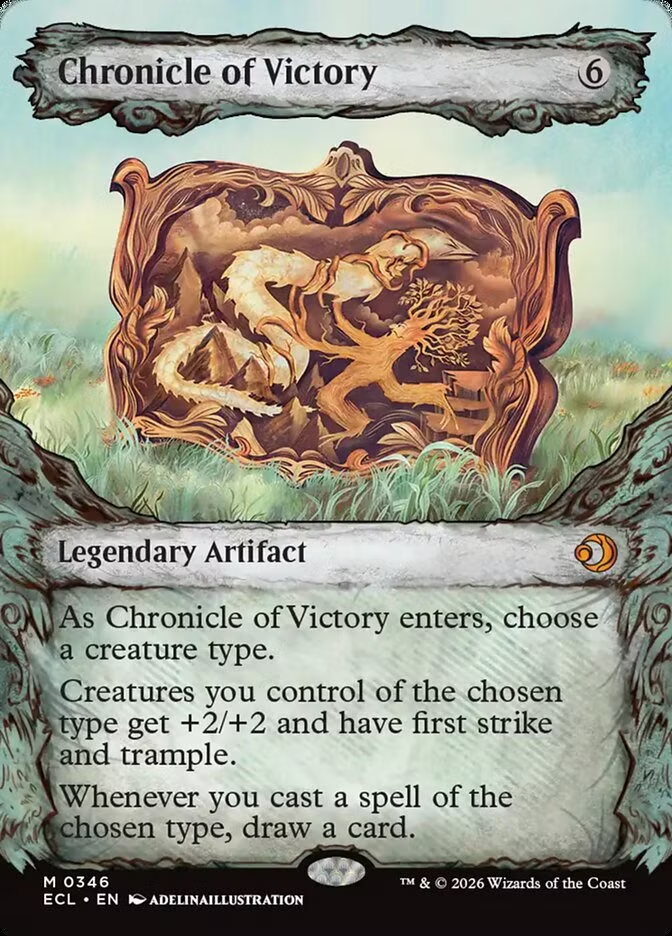
Lorwyn Eclipsed It also comes with the Mirrormind Crown, a piece of equipment that attaches to a creature. Whenever you want to create one or more tokens, you can create tokens that are copies of the equipped creature. This is a bit risky since this deck has a lot of legendary creatures, but I have Curious Colossus, a giant non-legendary warrior that turns all of an opponent’s creatures into 1/1 cowards. Another typical highlight is Bloodline Bidding, an eight-cost black spell with summon (creatures can tap to help you pay the cost), which returns all creature cards of the chosen type in your graveyard to the battlefield.
I still have some work to do before everything feels perfect for this deck, which I called Warriors of Strife, and I still need to tweak the mana base to make it more balanced. I feel like this is a commander deck that I’ll be playing with constantly, like it’s a revolving door of warrior heroes from each new set that comes out. For now, he’s in a great place. Here’s a look at Moxfield’s platform, where work is constantly in progress. If you have any tips on cuts, fits, or singles I should buy, feel free to let me know in the comments.
Soruce: polygon.com