For most of human history, strength did not need a mark. If someone had thick wrists, a heavy walk, a back slightly curved forward, one might assume that the day had demanded something of him. Fields had to be tilled, stones moved, wood cut and transported. The agency registered the requirement. Being muscular, what we might now call shredded, or even just “looking sexy,” was not a goal in itself; It was the byproduct of the work that had to be done.In a post-industrial world, that record has become elective. Broad shoulders now belong to both those who spend the day in front of a screen and those who transport goods. The link between physique and profession has loosened; You can no longer read a person’s profession in their posture.
The most sculpted bodies in a city are usually built in air-conditioned rooms, under fluorescent lights, lifting stainless steel that serves no purpose other than lifting it. We run on belts that take us nowhere. Proteins are shaken in matte black bottles, heart rates and calories flash on portable screens, macros are tracked with devotional precision, and compression fabrics are worn as uniforms. A subculture hums about supplements, powders, and optimization metrics.

You can no longer read a person’s profession in their posture.
We easily talk about “trying hard” even when the work that defines our careers leaves no mark on our bodies. The effort has become aesthetic. The product is not wood, stone or steel. It is the body itself, a project in continuous optimization.
The treadmill economy and the viral video
In a world where gyms already operate as commercial ecosystems, monthly subscriptions, branded supplements, premium tiers, personal trainers, influencer discount codes, it’s not too difficult to imagine that all that effort could be put into more “productive” use. If thousands of bodies already burn energy every morning on polished studio floors, why not capture it? Why not convert calories into electricity?The feasibility of all this can be discussed later. To invoke a couple of optimistic lines that have inspired many great undertakings: Plato’s. “necessity is the mother of invention” and George Herbert “where there is a will, there is a way.” History suggests that we take those feelings seriously when circumstances get tough. We have reorganized work, redesigned borders, built cities in deserts, and created chips and computers from sand and stone. And if turning people into energy sources seems morally excessive, it would be wise to remember that throughout history we have accepted harsher systems for weaker justifications. One imagines that, at the very least, we would all come out remarkably fit.
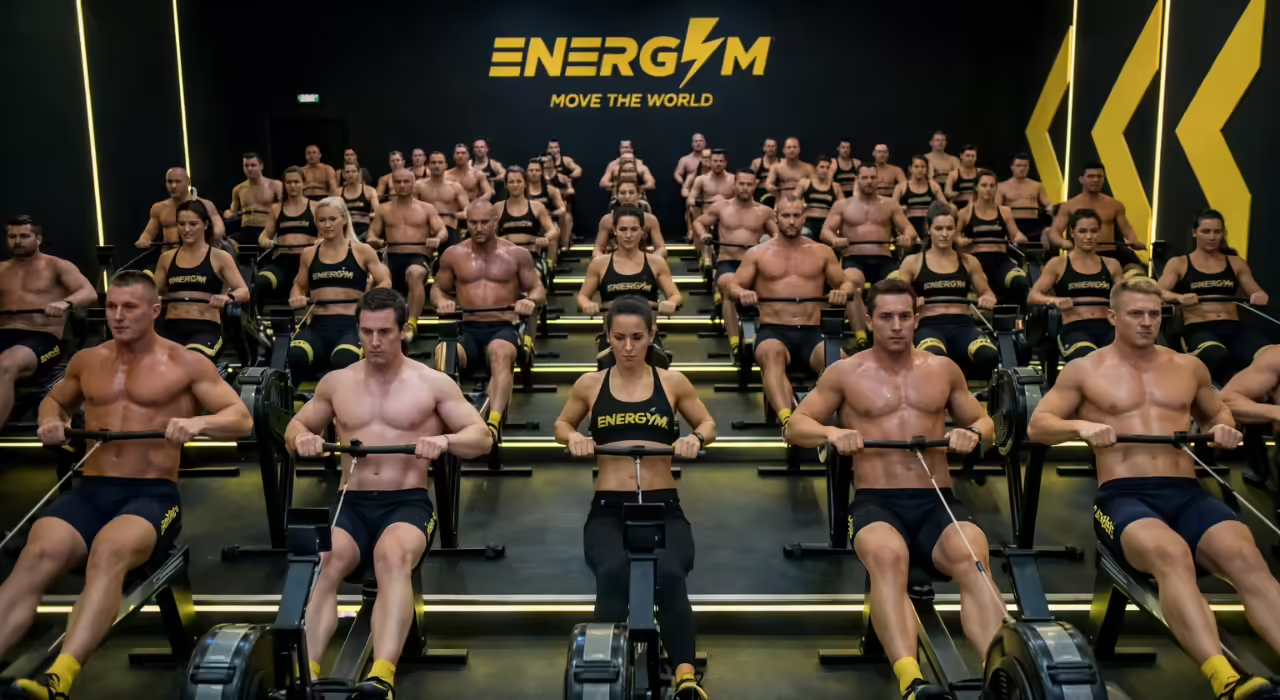
If we momentarily set aside the issue of servitude to machines, one suspects we would at least be surpassing our fitness goals.
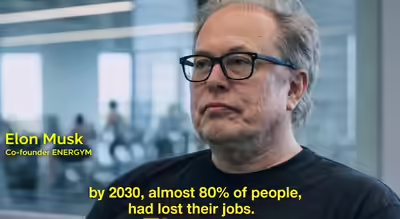
Now let’s place that thought in the near future, say 2030, where automation has swallowed up 80 percent of jobs, leaving billions of people redundant, who still need money to get by, but perhaps need purpose even more. What remains as a universal credential? Limbs that move. A body that can push itself. In a fragmented labor market, that becomes the only qualification that almost everyone still possesses.The idea is not mine, no matter how tempting it may be to claim it. I’ve joked many times about the theatricality of gym culture, about performing efforts in rooms full of mirrors. But the version circulating is a forty-second AI-generated video, and it leans toward more serious thinking than satire would allow.The premise is conveyed through hyper-realistic versions of Elon Musk, Jeff Bezos and Sam Altman, who look five years older and are sitting together as co-founders of a fictional company called Energy. His company’s proposal is simple: if artificial intelligence systems and robotics have displaced most forms of employment, let humans generate electricity through exercise and feed it back to the infrastructure that replaced them. Pay them for it. Frame it, as Altman’s avatar would later describe it, as a solution that “solved our need for energy and their need for purpose”—recruitment rather than redundancy.
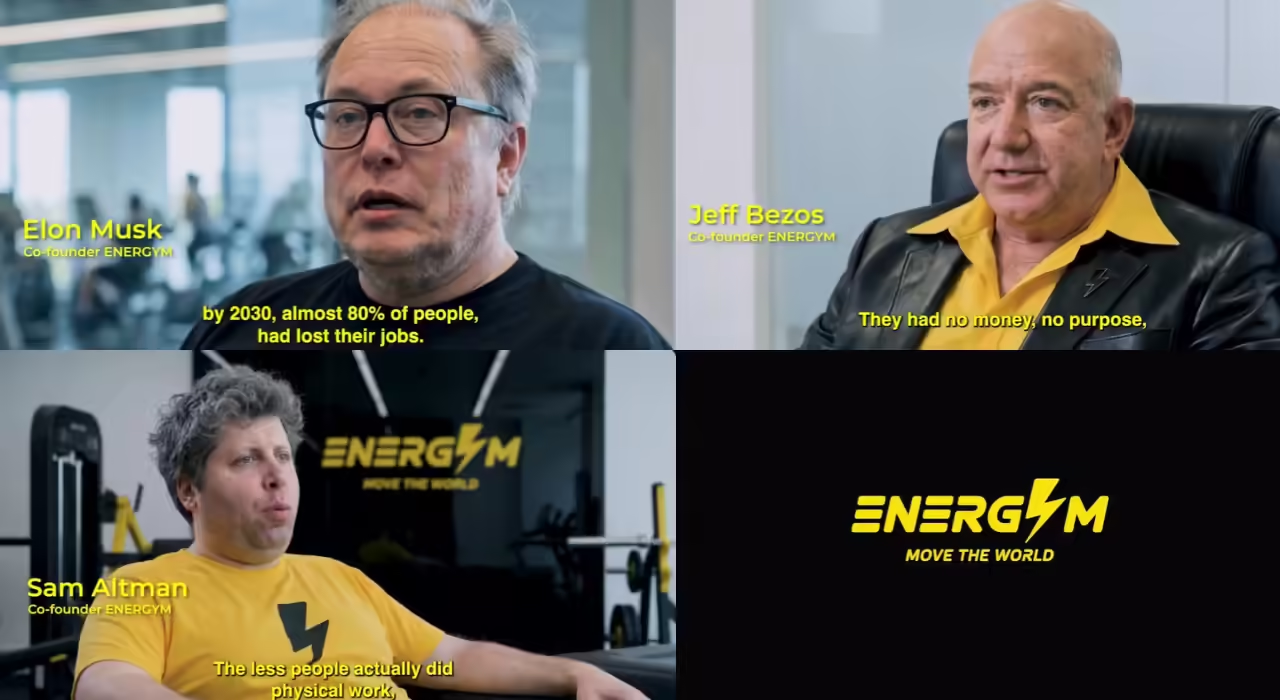
Stills from a 40-second AI-generated commercial by Hans Buyse and Jan De Loore on AiCandy
The speech is based on a tacit recognition that money alone would not solve the vacuum created by mass unemployment and that without work the day loses its structure. Even a wealthy but unmoored character hanging around a big house, the familiar TV trope of a spouse left alone once the husband goes to work and the kids go to school, illustrates how provision does not equal purpose. Work, for better or worse, has long functioned as a test of usefulness. Eliminate it and something more destabilizing than income is gone. ID@undefined Title not available.ID@undefined Title not available.Energym’s pitch takes advantage of that investment. If millions are no longer needed for traditional work and they still seek the structure and validation that work once provided, the exercise can be recoded as employment. Install generators on the equipment. Let human effort produce electricity that powers the AI data centers that made their previous careers obsolete.
The Black Mirror Parallel
Anyone familiar with the British dystopian anthology series black mirrorwhich first aired in 2011, you’ll recognize the structure immediately. Its second episode, Fifteen million meritsis set in a closed, autonomous world where people spend their days riding stationary bikes to generate electricity. The bikes power a vast, screen-saturated complex in which they also live; there is no visible life beyond it. In exchange, passengers earn “merits,” a digital currency used to purchase food and other basic needs, along with small digital luxuries that make confinement more bearable.Each person lives in a small gray room lined entirely with screens; there is no window in the conventional sense, only moving images. Ads are constantly interrupted and trying to avoid them is not an option. If a rider closes their eyes or looks away, the screen emits a piercing alarm, flashes red and displays a command to “CONTINUE WATCHING,” the sound persisting until they look again. Muting or skipping the announcement results in merit deduction. Attention is required.
Even identity is mediated by a digital avatar, known as “Doppel” (short for doppelgänger), who functions as the substitute for the individual in this closed world, in games, in social spaces, in the talent show like “Hot Shots” that promises escape. Passengers spend their hard-earned merits customizing these avatars with new hair, clothing, and accessories—small cosmetic upgrades that indicate status within a system that offers little else.Society is stratified. Those fit enough to pedal form the middle tier. Those who gain weight or can no longer handle the physical demands are demoted to a clean class known as “lemons.” They wear yellow uniforms, clean up after cyclists and are openly ridiculed. In the video games that riders play, they appear as targets, and some are pushed into a grotesque internal program called upset stomacha virtual game show created to humiliate them for entertainment. Class contempt is not incidental; It is structured in the system, very similar to ours.The only apparent escape is a talent competition called “Hot shot”and entry costs 15 million merits, a sum that typically takes years of cycling to accumulate. The protagonist, bing He can afford it because he inherited the merits from his brother, who recently died. Instead of spending it on himself, he gives the entire amount to abia quiet singer he has approached, convinced that her talent could offer a way out of the closed world they inhabit. He acts sincerely, but the judges dismiss his voice as ordinary and focus on his appearance, offering him a spot on an adult entertainment channel instead of the artistic recognition he hoped for.Humiliation is not an immediate spectacle; gradually unfolds on the screens surrounding Bing’s room. In response, he gets back on the bike and spends months pedaling to earn another 15 million merits for his own audition. When he finally takes the stage, he doesn’t sing. She speaks, holding a shard of glass to her throat as she denounces the emptiness of the system that has commodified everything, including Abi’s dignity. The judges listen, deliberate, and decide that their anger has commercial potential. Instead of punishing him, they offer him a contract, a larger living space, and a regular platform from which to deliver rehearsed versions of the same atrocity, now packaged as entertainment within the very structure he sought to challenge.
The bikes in that episode apparently generate power. However, the most persuasive reading is that they generate compliance. They exhaust the body, occupy the mind and make money circulate again in the same closed circuit of consumption. Users spend merits to skip ads or buy digital clothing for avatars that only exist on screens. It’s hard not to see in that loop a reflection of the extent to which modern work functions less as an intrinsic necessity and more as participation in a hyper-consumption economy, where effort sustains the system itself rather than producing something fundamentally necessary for survival.He Energy The concept borrows this architecture but replaces anonymous supervisors with familiar tech moguls. Instead of merit, offer purpose. Instead of a bunker, it offers the open promise of employment. The mechanism is the same: effort sustains the system; the system maintains the illusion of upward mobility.If you think this sounds far from our present, consider how frequently digital economies already trade in status symbols. In games like Fortnite, players spend real money on cosmetic “skins” that alter appearance without altering ability. On platforms like snapchatusers select Bitmojis and filters to signal belonging or aspiration. We pay to skip ads. We upgrade to premium levels to eliminate interruptions. Even dissent returns to the system; Bing Fury lets you choose between monetizing it or getting back on track, and in our own media ecosystems outrage often survives only if it generates engagement. The mechanics may be less coercive, but the pattern is familiar.
The matrix and battery logic
Long before Black Mirror imagined people pedaling to survive, The Matrix had already presented a harsher scenario. In his backstory, humans create intelligent machines, lose control of them, and a war ensues. In a last-ditch attempt to weaken their opponents, they burn the sky to block out the sun, cutting off the machines’ primary power source. The machines adapt. They turn to what remains in abundance: human beings.
Humans grow and are suspended in capsules, their minds connected to a simulated reality of the late 20th century, while their bodies generate bioelectrical and thermal energy to power mechanical civilization. Morpheus tells Neo clearly that the Matrix exists to keep humans under control while using them as batteries. Early drafts reportedly imagined humans as organic processors rather than literal energy cells, but the premise hasn’t changed: human life becomes a resource within a system designed to sustain itself, and that’s the reorganization Energym suggests. The difference is that this time the arrangement would arrive wrapped in the chosen language. You enter the gym. You register. You generate energy. But if work elsewhere has disappeared and survival still depends on income, how voluntary is that choice? Consent is starting to look a lot like a necessity.
Does Sam Altman see humans as batteries ?
If Energym’s video is disturbing, it is partly because its fictional co-founder is not an obscure character but a recognizable figure. Sam Altman is not just another technology executive; runs OpenAI, the company that launched ChatGPT and accelerated what many now describe as the first large-scale AI race. When someone in that position talks about energy, efficiency and the future of intelligence, it is not an idle comment. The executives at the center of this transition shape the direction of capital, research and policy, and the way they frame the problem often indicates where they think the industry is headed.In a recent discussion about AI’s environmental footprint, Altman responded with a rephrasing rather than a denial:“One of the unfair comparisons here is that people talk about how much energy it takes to train an AI model versus how much it costs a human to perform an inference query. It also takes a long time to train a human. It takes 20 years of your life and all the food you eat during that time before you become smart. Not only that, it took a very broad evolution, like that of a hundred billion people who once lived, who learned not to be eaten by predators and learned how to invent science to produce you. The fair comparison, if you ask ChatGPT a question, is how much energy it takes to answer that question compared to a human. And AI has probably caught up in terms of energy efficiency in that way.”Altman made these statements at the recently concluded meeting AI Impact Summit in India, in response to questions about the environmental cost of training large models. The point I was making was technical, almost accounting in nature, but the framing persists. In that comparison, the human being is described as a long process of formation, twenty years of feeding, schooling, and evolutionary inheritance before “inference” begins, while evolution itself becomes a kind of preformation phase spanning millennia. The language is not cruel, but it is clinical. Food becomes an input cost, childhood a period of exhaustion and intelligence an energy equation that must be optimized.
The comparison does not attack humanity; measures it. Biological and artificial intelligence are placed on the same grid and evaluated based on expenditure and efficiency, as if both were systems competing for resource allocation. Once that lens is adopted, it becomes easier to see how value can drift toward outcome rather than experience, toward optimization rather than meaning.It’s hard not to be reminded of the Architect of The Matrix, which treats humanity as a variable to be managed within a larger design. In this way of thinking, the central question is not what a human life means but what it produces and how easily it fits into the structure around it. And from that point of view, Energym’s proposal no longer seems like a piece of speculative satire. If you are already comparing human beings in terms of energy input and productive return, then redirecting your physical effort towards the network begins to look like a continuity rather than a rupture.What persists is how narrow the distance between those imagined worlds and our own now seems. Matrix reduced the body to infrastructure. Black Mirror reduced the effort of currency within a sealed system. Energym is, on paper, another fiction. We like to think of this as hype, but much of logic, optimization, commitment, and productivity at any cost is already present in daily life.