What is Asif Ali Zardari’s net worth?
Asif Ali Zardari is a Pakistani politician who has a net worth of $1.8 billion. He is one of the richest people in Pakistan.
For several decades in public life, Zardari has been a controversial but enduring figure in Pakistani politics, dealing with accusations of corruption, imprisonment, political exile and a dramatic return to power. He first rose to national prominence through his marriage to Benazir Bhutto, daughter of former Prime Minister Zulfikar Ali Bhutto and the first woman to lead a Muslim-majority nation. During Bhutto’s two terms as prime minister in the late 1980s and mid-1990s, Zardari held several government positions and earned a reputation as a powerful political operator. Critics frequently accused him of corruption, earning him the nickname “Mr. Ten Percent,” although many cases against him were eventually dismissed or collapsed. After Bhutto’s assassination in 2007, Zardari quickly emerged as the leader of the PPP alongside his son Bilawal Bhutto Zardari. In 2008, he was elected president of Pakistan, leading the country through a critical period that included constitutional reforms that reduced presidential powers. Years later, he returned to national office when he was sworn in again as Pakistan’s president in 2024, following a coalition agreement between the major political parties.
Early life
Asif Ali Zardari was born on July 26, 1956 in Karachi, Sindh province, Pakistan. He comes from a prominent and wealthy Sindhi family involved in both politics and business. His father, Hakim Ali Zardari, was a well-known politician and landowner who served in Pakistan’s parliament and held various government positions. His mother, Bilquis Zardari, was active in social and charitable circles.
Zardari was educated in Pakistan and abroad. As a young man, he developed interests in business, agriculture, and equestrian sports. Before entering politics, he was primarily known as a businessman involved with his family’s agricultural and real estate holdings.
His life changed drastically in 1987 when he married Benazir Bhutto. According to Pakistani cultural traditions, the marriage was arranged by their families. Bhutto would soon become one of the most important political figures in the country’s history.
Rise to political prominence
In 1988, Benazir Bhutto was elected prime minister of Pakistan, becoming the first woman to lead a Muslim-majority nation. His rise instantly thrust Zardari into the center of national politics. Although he initially remained behind the scenes, he quickly became a political figure and influential advisor.
Bhutto’s government faced intense opposition from her political rivals and Pakistan’s powerful military establishment. His first administration was dismissed in 1990 amid accusations of corruption and mismanagement. During this period, Zardari was arrested and imprisoned on corruption charges, beginning a pattern of legal battles that would follow him for years.
Bhutto returned to power in 1993 and Zardari became more directly involved in the government. He served as a member of the National Assembly and held several cabinet-level positions, including Minister of the Environment and Minister of Investment. His growing influence made him both powerful and controversial.
Critics accused him of using political connections to accumulate wealth through bribes and kickbacks on government contracts. These accusations gave rise to the nickname “Mr. Ten Percent”, which became widely associated with his public image.
Imprisonment and legal battles
In 1996, Bhutto’s government was again dismissed amid allegations of corruption. Shortly afterward, Zardari was arrested on charges ranging from corruption to involvement in a political assassination. He spent several years in prison awaiting trial.
In 1997, while still imprisoned, Zardari was elected to the Pakistan Senate, demonstrating his continued political influence despite legal turmoil. Over the next few years, numerous corruption cases were filed against him in Pakistan and abroad.
In 2003, a Swiss court convicted Zardari and Bhutto of money laundering and ordered them to return millions of dollars to the Pakistani government. The ruling was later overturned on appeal. Many other cases ultimately collapsed due to lack of evidence, legal technicalities, or political amnesty measures.
Zardari remained in prison for about eight years before being released in 2004. By then he had spent much of the previous decade fighting legal battles and navigating Pakistan’s volatile political landscape.
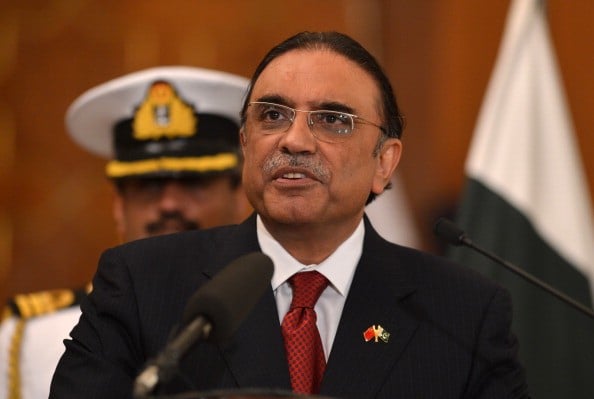
(AAMIR QURESHI AFP/Getty Images)
Return to politics after the assassination of Benazir Bhutto
On December 27, 2007, Benazir Bhutto was assassinated during a political rally in Rawalpindi, a murder that shocked Pakistan and the international community. Zardari subsequently emerged as the central figure responsible for maintaining the leadership and unity of the Pakistan People’s Party.
Following Bhutto’s death, Zardari and his son Bilawal Bhutto Zardari were appointed co-presidents of the party. The PPP soon won the largest number of seats in Pakistan’s 2008 parliamentary elections.
Later that year, Zardari was elected president of Pakistan by the country’s parliament and provincial assemblies. He was sworn in on September 9, 2008, becoming the country’s eleventh president.
Presidency (2008-2013)
Zardari’s presidency came during a turbulent period for Pakistan, marked by economic instability, terrorism and shifting political alliances. His administration oversaw a series of important political developments.
One of the most important changes was the passage of the 18th Amendment to Pakistan’s constitution in 2010. The reform transferred many powers from the presidency to parliament and the prime minister, reversing constitutional changes made during the previous military government.
Zardari also played a key role in strengthening civilian democratic institutions after years of military dominance in Pakistani politics. His term ended in 2013, marking the first time that a democratically elected Pakistani president completed a full constitutional term and peacefully transferred power to a successor.
Later political career and return to the presidency
After leaving office in 2013, Zardari remained an important figure within the Pakistan People’s Party and continued to influence national politics. He returned periodically to parliament and helped guide the PPP’s electoral strategies along with his son Bilawal.
His subsequent political career was again marked by legal challenges. In 2019 he was arrested in connection with allegations of suspicious financial transactions and money laundering through bank accounts allegedly in other people’s names. He was later released on bail on medical grounds and the court process continued for several years.
Despite the ongoing controversies, Zardari remained politically active. In 2024 he returned to the presidency after Pakistan’s parliamentary elections produced a coalition government formed by the Pakistan Muslim League-Nawaz and the Pakistan People’s Party. On March 10, 2024, he was sworn in as the country’s fourteenth president.
Legacy
Asif Ali Zardari’s political career is one of the most complex and controversial in Pakistan’s modern history. He has spent years in prison, faced numerous corruption charges and endured intense political opposition. At the same time, he has demonstrated remarkable political resilience, repeatedly returning to positions of influence.
His supporters credit him with helping to stabilize Pakistan’s democratic system during a fragile period following military rule and political violence. Critics argue that corruption allegations and political deals have long overshadowed his legacy.
Regardless of perspective, Zardari remains one of the most important figures in Pakistan’s political landscape, with a career that has shaped the leadership of the Pakistan People’s Party and the country’s broader democratic evolution for more than three decades.
All net worths are calculated using data extracted from public sources. When provided, we also incorporate private advice and feedback received from celebrities or their representatives. While we work diligently to ensure our figures are as accurate as possible, unless otherwise stated, they are estimates only. We appreciate all corrections and comments using the button below.