For people who enjoy reading stories about extreme wealth, March 13 should be a holiday. If it were a holiday, today we would be celebrating the 40th anniversary of the launch of one of the greatest wealth creation machines in human history. What happened 40 years ago today? That was the day a small Seattle software company called Microsoft went public.
The events of March 13, 1986 would end up generating thousands of millionaires, a handful of billionaires and three of the largest personal fortunes in the history of humanity. A decade after its IPO, the company’s co-founder, Bill Gates, would be the richest person in the world, a title he held for the better part of 20 years.
How much wealth did Microsoft generate for its founders and where is that wealth today? How rich would you be today if you had been lucky enough to buy $10,000 worth of MSFT on March 13, 1986 and hold it for the next 40 years, collecting dividends and new shares from stock splits? Let’s find out!
Early history of Microsoft
Microsoft was founded by childhood friends Bill Gates (20 years old) and Paul Allen (22 years old) in Albuquerque, New Mexico, on April 4, 1975. Yes, that’s right, Albuquerque. Not Seattle. The reason the company was founded in Albuquerque is because it happened to be the hometown of a company called Micro Instrumentation and Telemetry Systems (MITS).
Allen and Gates met while both attended Seattle’s Lakeside School. They bonded over their love of computers and programming. Allen was two years older than Gates. After earning a perfect SAT score, Allen enrolled at Washington State University. He dropped out after two years and took a job at Honeywell in Boston, whose offices were just minutes from Harvard, where Bill had recently enrolled.
[Fun fact – Lakeside School’s prestige extends in funny ways. Back in 2021, MacKenzie Scott (ex-wife of Jeff Bezos), briefly married a man named Dan Jewett. Dan was a science teacher at… Lakeside School!]
In January 1972, Popular Electronics magazine did an article on MITS’s latest invention, the Altair 8800 microcomputer. According to legend, Paul saw the magazine’s cover while walking through Harvard Square. He bought the magazine, tracked down Bill, and frantically convinced him that they both needed to leave Boston (Bill was in the middle of his junior year) and move to Albuquerque, where they would build an operating system for Altair.
That’s exactly what happened.
MITS executives were impressed with their operating system and hired the young duo to create software for the company. But Allen and Gates had bigger ideas and soon struck out on their own.
On April 4, 1975, Bill Gates and Paul Allen founded “Micro-Soft” in Albuquerque.
In 1976, “Micro-Soft” generated $16,005 in revenue selling software for some of the world’s first personal computers.
In January 1979, after removing the hyphen, Microsoft moved to Seattle. In addition to being closer to their childhood homes, Gates and Allen found it difficult to recruit high-quality programmers to move to New Mexico.
Steve Ballmer, one of Bill’s friends from Harvard, became Microsoft’s 30th employee on June 11, 1980. He was hired to head business development.
That same year (1980), IBM announced its intention to hire a software company to develop an operating system that would become standard for all IBM personal computers. IBM initially approached Microsoft. Incredibly, Gates suggested that they contact his friend Gary Kildall in the Bay Area, the founder of a company called Digital Research, Inc., which had already developed an operating system that could be adapted to IBM machines. Gates even went so far as to call Gary while the IBM people were still in his office, so they could set up a time to meet the next day.
Depending on who you talk to, Gary’s meeting with IBM was a failure for a couple of different reasons. Here’s what is known: When the IBM executives arrived for their meeting, they were greeted by Gary’s wife, Dorothy. Gary, for reasons that have been debated for decades, missed the meeting because he was flying his plane. IBM’s stuffy executives were outraged. They flew back to Seattle and asked Bill if he would reconsider creating their operating system.
Bill said yes.
There was only one problem. Microsoft was nowhere near developing what could be used as an operating system for IBM. So Bill called a Seattle-based developer named Tim Paterson, who had developed a clone of Gary’s software, which he called “86-DOS.” Bill negotiated a deal to purchase 86-DOS for $100,000.
Bill and his team made a couple of nominal changes. They also changed the name of the operating system from “86-DOS” to MS-DOS.
The IBM team was very happy with what they saw in MS-DOS and wanted to establish a formal partnership to make it the standard operating system for all their machines.
In what is arguably the most brilliant move in business history, rather than sell the rights to MS-DOS directly to IBM, Gates opted to license the software. As a result, Microsoft retained ownership of MS-DOS and was therefore able to license it to new customers.
Step back for a moment and digest the meaning of that decision.
Imagine if Henry Ford hired you to invent an engine for his car. And imagine if instead of selling your creation to you directly, it licensed you to earn a fee every time a Ford car was sold. Then, as new car companies appear like Dodge, Buick, Chevrolet, Ferrari…etc…, you license your engine to them as well. So you earned a royalty every time a car was sold for over 100 years.
That’s exactly what happened with Microsoft. As the PC revolution exploded around the world, MS-DOS became the standard for virtually every computer ever built. And every time someone bought a PC, they were also forced to buy an MS-DOS license from Microsoft.
When Steve Ballmer first joined Microsoft in 1980, he actually had no equity; had a 10% profit sharing agreement. However, when the company was officially incorporated in 1981, it traded that unsustainable share of profits for an 8% shareholding. Here’s how ownership shook out among the big three at the time of its addition:
- Steve Ballmer owned 8%
- Paul Allen owned 25%
- Bill Gates owned 45%.
- The remaining 22% was divided among some of the luckiest people to ever join a young, risky startup.

FINDLAY KEMBER/AFP/Getty Images
“The graphical user interface”
In 1983, Xerox developed a revolutionary operating system that connected the PC mouse to the computer screen. For the first time, a human could move his hand and the mouse followed him. Point, click. Drag, drop. It was originally called “point-and-click graphical interface”. More commonly known today as a “graphical user interface” (GUI, pronounced “Gooey”). This small innovation remains the standard in all computers to this day.
For some strange reason, Xerox invited executives from Apple and Microsoft to see what they had created. They literally invited Bill Gates and Steve Jobs to see a demonstration. This would be like inventing a new type of alcohol that doesn’t cause a hangover and then inviting executives from major alcohol companies to come and check the ingredients.
Within months, both Apple and Microsoft were working on their own operating systems that had point-and-click graphical mouse interfaces.
When Steve Jobs learned that Microsoft was also working on an operating system based on Xerox innovations, he was furious. He demanded that Bill Gates go to Apple headquarters and account for his actions. Here’s how that legendary interaction played out in an Apple conference room:
Jobs shouted: “You are scamming us! I trusted you and now you’re stealing from us!“
Gates sat calmly on the other side of the conference room as Steve vented his fury. When the Apple founder finished, Gates responded:
“Well, Steve, I think there’s more than one way to look at it. I think it’s more like we both have a rich neighbor named Xerox, and I broke into his house to steal the TV and found out that you had already stolen it.“
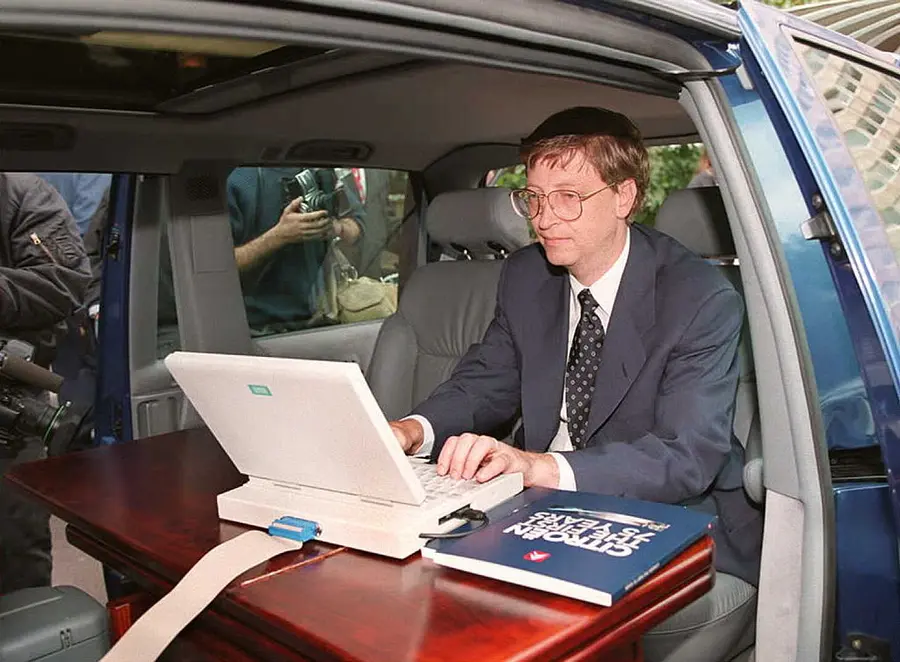
Bill Gates in 1995 (Michel GANGN/AFP via Getty Images)
Microsoft Windows was released on November 20, 1985. Within months, the PC became the global computing standard and subsequently left Apple by the wayside for more than a decade. And every time a PC was sold, Microsoft earned a handsome royalty check for its software.
Over the next few months, Microsoft would slowly gain a number of new private investors. According to Securities and Exchange Commission regulations, once a company has more than 500 private shareholders, must be made public. Therefore, an initial public offering was inevitable, even though Bill Gates would have preferred to remain public.
March 13, 1986 – IPO DAY
Microsoft wasn’t the first software company to go public in the mid-1980s. It wasn’t the only software company to go public in March 1986! Literally one day before Microsoft went public, Larry Ellison’s Oracle Corp went public. Oracle planned to offer 2.1 million shares at $15 each. At the end of its first day of trading, Oracle shares were trading at $19.25. This was seen as a very positive sign by the bankers guiding Microsoft’s debut, so the opening price of MSFT was raised from $16 to $21.
At 9:35 a.m. on March 13, 1986, MSFT opened at $25.75 per share. The CEO of Goldman Sachs could be heard shouting in the trading room:
“It’s wild! I have never seen anything like this: every last person here trades with Microsoft and nothing else!“
At the end of trading, 3.6 million MSFT shares had been traded and the share price (which had reached a high of $29.25) ended the day at $27.75.
So how much were Gates, Allen and Ballmer worth after their successful IPO? 10 billion dollars? 20 billion dollars? 50 billion dollars? 100 billion dollars???? No, no, no and no. Microsoft ended the day with a total market capitalization of $780 million.
- Gates’ 45% stake was worth it $350 million
- Allen’s 25% stake was worth $195 million
- Ballmer’s 8% stake was worth it $51.5 million
That’s right, Bill Gates was worth “only” $350 million after Microsoft’s IPO. What’s even crazier is the fact that he personally only sold $1.6 million worth of stock on inauguration day. I wasn’t even in Seattle when the company went public. Bill was in Australia on vacation on the day of the IPO. He would eventually use $150,000 of the proceeds from his initial public offering to pay off the mortgage on his home in Seattle.
Paul Allen, who was at least in Seattle on the day of the IPO, told a local newspaper that he was “very happy” and “might go out for champagne later to celebrate.” What a pair of maniacs!
Fortunes made
This is what happened to Microsoft in the 40 years since it became a public company.
Microsoft (both the company and the stock price) grew at an incredible rate after going public. In 1990, annual revenues exceeded $1 billion. In 1997, the company generated $10 billion in revenue. In its most recent fiscal report through 2026, Microsoft generated more than $281 billion in annual revenue and more than $101 billion in net income.
At the time of writing, the company has a market capitalization of over $3 trillion. A few months ago, the company’s market capitalization very briefly reached $4 trillion.
Bill Gates officially became a billionaire for the first time about a year after the IPO in 1987. In the mid-1990s, when his net worth surpassed $10 billion, Bill was anointed the richest person in the world, a title he held unchallenged for the next twenty years. His net worth surpassed $40 billion for the first time in 1997. In 1999, at the height of the dot-com craze, his net worth surpassed $100 billion for the first time.
As of this writing, Bill Gates has a net worth of approximately $117 billion. Interestingly, he doesn’t actually own Microsoft that much anymore. Today, Bill owns less than 1% of the company he founded. He has donated tens of billions of dollars to charities and intends to give away most of his fortune before he dies.
Now obviously having a net worth of $117 billion is amazing, BUT! Consider this: Let’s say Bill wasn’t all that aggressive in selling Microsoft stock over the years. Let us remember that at the time of the IPO it owned 45% of the company. Let’s say you sold it to the point that you still own 30% today. At the current market capitalization, he would be a billionaire.
In fact, Paul Allen left Microsoft in the mid-1980s, but remained on the company’s board of directors until 2000. Paul used his fortune to invest in companies like Dreamworks and an impressive real estate portfolio. He owned three sports teams: the Seattle Seahawks, Seattle Sounders FC and the Portland Trailblazers. He had a net worth of $20 billion at the time of his death in October 2018. All of his wealth will eventually be donated to charity. The farm is currently managed by his sister Jody Allen.
Steve Ballmer took over as CEO of Microsoft in 2000, when Bill Gates retired from the company. He served as CEO until 2014. He still owns about 333 million Microsoft shares and has a net worth of about $183. Notice how that actually makes him RICHER than Bill Gates today! Ballmer owns the Los Angeles Clippers. As of this writing, he has NOT joined Bill Gates’ Giving Pledge, although he and his wife have increasingly increased their philanthropic giving.
$10,000 invested in 1986
So how much would you be worth today if you bought a bunch of MSFT stock and held it for 40 years?
If you had purchased $10,000 worth of Microsoft on the day of the IPO, you would have been able to purchase 476 shares. After several stock splits and dividend reinvestments, today you would own 137,088 shares.
At today’s closing price of about $405 per share, your stake would be worth about 55.5 million dollars.
With Microsoft’s current annual dividend of $3.64 per share, you would receive approximately $498,999 per year in completely passive income.