Canon aims to change the video conferencing game with a new virtual reality (VR) platform called Kokomo. Basically, it leverages Canon’s cameras to make interacting with others on video calls an experience closer to talking in person.
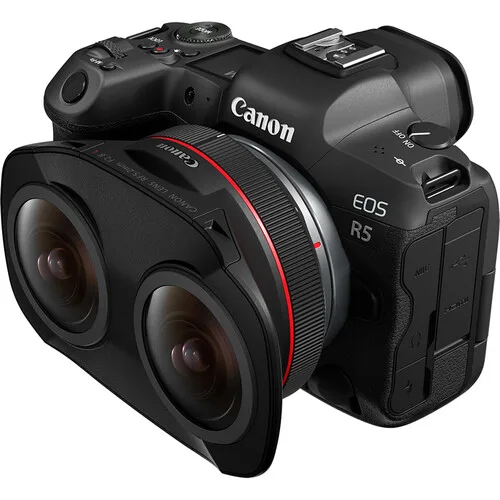
Canon created Kokomo as a software solution that leverages a VR headset connected to a smartphone and a Canon camera equipped with Canon’s new RF 5.2mm F/2.8 L Dual Fisheye lens. Canon is currently showing off the system using the Eos R5 full-frame mirrorless camera, but compatibility with other Canon cameras will be added later along with new features.
Canon describes Kokomo as software that lets you interact with real-time recordings of other people in realistic virtual environments like Malibu, California, New York or Hawaii (more locations will be added over time). Think of it like using the green screen effect in Zoom to make it look like you’re somewhere else. However, with Kokomo, the experience will be much more immersive.
Canon calls this the “Real Together Experience,” and the goal is to make the people you’re talking to feel like they’re in the same room as you when talking over the Internet, rather than just sharing a two-dimensional video or fake digital avatar. If Canon is right, these technologies will allow people to better connect with others during online interactions.
It’s not yet known exactly what equipment will be compatible with Kokomo, but it’s clear that it will require a fairly expensive setup to get it to work. If the system only works with a high-end Canon camera, a dual fisheye lens, and a compatible VR headset, using Kokomo would cost roughly between $5,000 and $7,000. Also, consider that communicating with others who use Kokomo requires specific and expensive equipment. Plus, we don’t yet know how much the software will cost or how it will be monetized.
I don’t think Kokomo in its current form is something everyone will buy to have in their home. It seems more suited to education, where businesses or schools that require one-on-one interaction over long distances can lend equipment to students, allowing them to participate remotely in realistic virtual classrooms. This could solve some of the fundamental problems with traditional videoconferencing that are causing these problems for many professions.
These mixed reality VR meetings could become common in the future as more accessible hardware becomes available. Kokomo will be a glimpse into our future just a few years from now.